
The review that has to clear
Here is the thing that leaves.
Most vendor security pages tell you what stays.This one starts with what does not, because that is the sentence you are looking for and you should not have to find it.
A senior partner wants this, so my concerns get waived.
That is the usual shape and it is bad for everyone. A waived concern is not an answered one, and it surfaces again at the worst possible moment. So the answers below are specific enough to approve or reject on, rather than reassuring enough to wave through.
What actually happens
What you get, specifically.
-
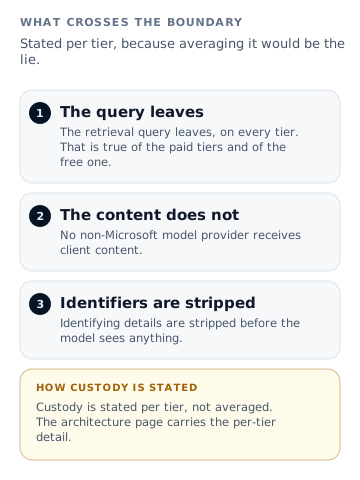
The retrieval query leaves, on every tier
Your question is sent to a shared corpus index that Technology Outlaws operates. The query transits even though your files do not. That is the carve-out, and it applies on Bring Your Own Azure too.
-
No non-Microsoft model provider receives client content
Inference runs on Azure OpenAI inside Microsoft Azure, reached over a private endpoint under managed identity rather than an API key.
-
Identifying details are stripped before the model sees anything
Presidio anonymisation runs over the payload first. There is no training on your queries, your documents or your matter memory.
-
Custody is stated per tier, not averaged
On Bring Your Own Azure your documents, derivatives and audit records stay in your own subscription and tenant. On the tiers Technology Outlaws operates, Technology Outlaws is a custodian of those records under contract.
What this does not do
The part we are not going to oversell.
On the tiers we operate, a subpoena served on Technology Outlaws reaches the instance and the shared index. We will not tell you there is nothing to reach, because there is, and a vendor who claims otherwise has not read their own architecture.
United States v. Heppner (S.D.N.Y. 2026): documents created with consumer AI carry no attorney-client privilege and are discoverable
Get the beta.
Buy any tier today, in beta. One email address, no sales call, and no demo gate standing in front of the product.
Get the betaGoes to a person at Technology Outlaws, not a queue.