The person who signs the brief
You are the one who signs it.
Rule 11 does not care which tool produced the citation.The signature is yours, and so is the sanction.
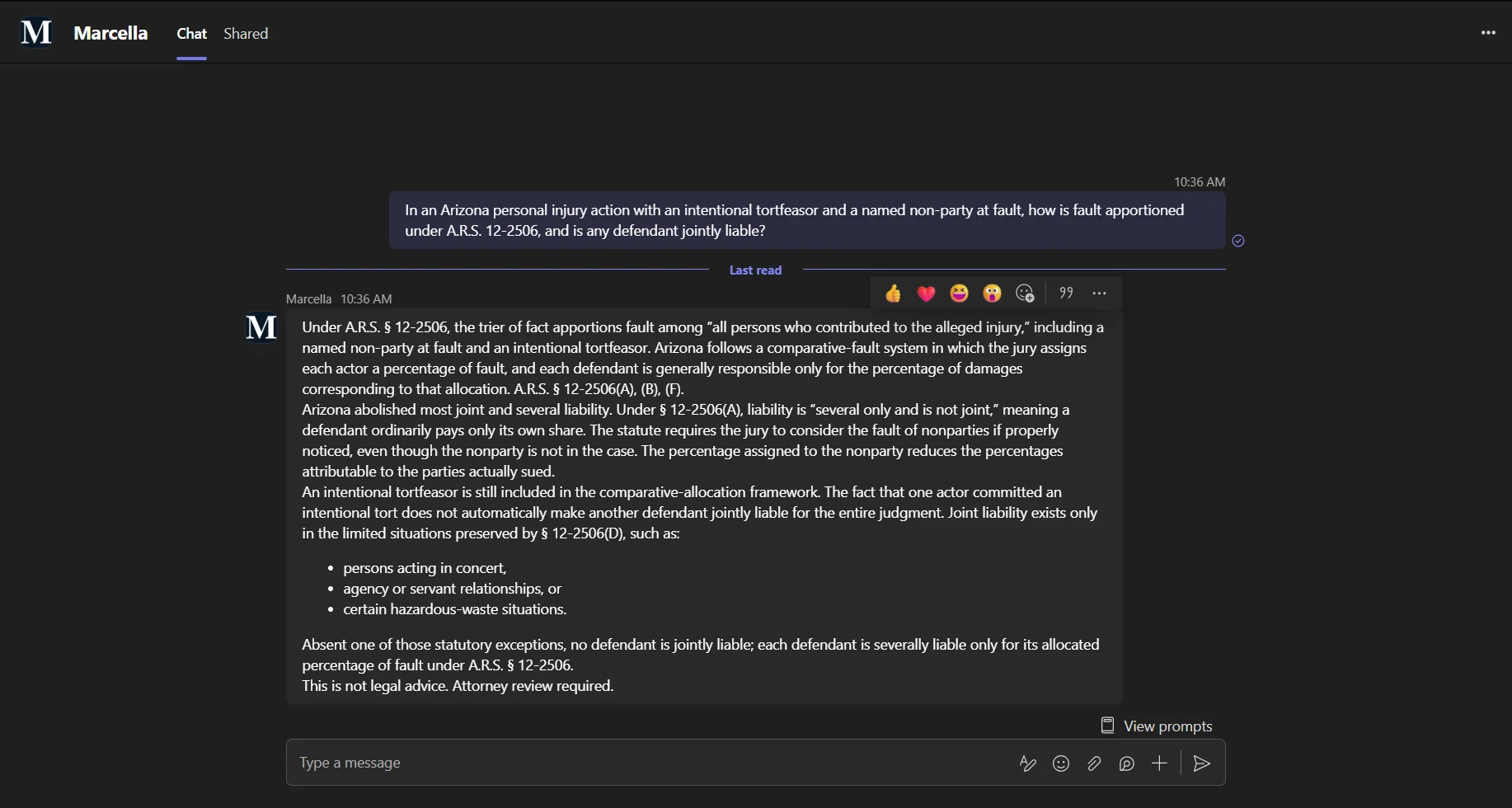
Read this answer as text
Asked In an Arizona personal injury action with an intentional tortfeasor and a named non-party at fault, how is fault apportioned under A.R.S. 12-2506, and is any defendant jointly liable?
Under A.R.S. § 12-2506, the trier of fact apportions fault among “all persons who contributed to the alleged injury,” including a named non-party at fault and an intentional tortfeasor. Arizona follows a comparative-fault system in which the jury assigns each actor a percentage of fault, and each defendant is generally responsible only for the percentage of damages corresponding to that allocation. A.R.S. § 12-2506(A), (B), (F).
Arizona abolished most joint and several liability. Under § 12-2506(A), liability is “several only and is not joint,” meaning a defendant ordinarily pays only its own share. The statute requires the jury to consider the fault of nonparties if properly noticed, even though the nonparty is not in the case. The percentage assigned to the nonparty reduces the percentages attributable to the parties actually sued.
An intentional tortfeasor is still included in the comparative-allocation framework. The fact that one actor committed an intentional tort does not automatically make another defendant jointly liable for the entire judgment. Joint liability exists only in the limited situations preserved by § 12-2506(D), such as:
- persons acting in concert,
- agency or servant relationships, or
- certain hazardous-waste situations.
Absent one of those statutory exceptions, no defendant is jointly liable; each defendant is severally liable only for its allocated percentage of fault under A.R.S. § 12-2506.
This is not legal advice. Attorney review required.
Transcribed from the capture above, read 2026-10-30. The wording is the product’s.
A question with a statute, a non-party and an intentional tort
Cited to the subsection, not to the statute.
Fault apportionment under A.R.S. 12-2506, with a named non-party at fault and an intentional tortfeasor in the case. The answer separates several liability from the joint liability preserved by subsection (D), and lists the three statutory exceptions rather than summarising them away.
Another research tool is another login I did not ask for.
Fair. Most legal AI asks you to change how you work and gives you back a confident paragraph you then have to check line by line. That is not a saving, it is a transfer of work from drafting to verification.
What actually happens
What you get, specifically.
-
Citations are retrieved, not generated
Every authority in an answer was pulled from an indexed corpus before the answer was written. If a case is not in the index it does not appear in the output, because there is nothing to return.
-
Treatment is checked before you file
Subsequent history comes back with the citation rather than after it. A case that was overruled reads as overruled while you are still drafting.
-
Six items, on every answer
What was retrieved, from where, how many authorities were checked, which carry history, and what the index could not confirm. The block is assembled from the retrieval step, not written by the model.
What this does not do
The part we are not going to oversell.
Marcella does not write your argument and does not know your matter strategy. It also cannot verify an authority that is not in the public record: Westlaw-only headnotes and some neutral citations come back marked absent rather than confirmed, and that is the honest answer rather than a silent pass.
Mata v. Avianca (S.D.N.Y. 2023), sanctions for filing fabricated case citations
Get the beta.
Buy any tier today, in beta. One email address, no sales call, and no demo gate standing in front of the product.
Get the betaGoes to a person at Technology Outlaws, not a queue.